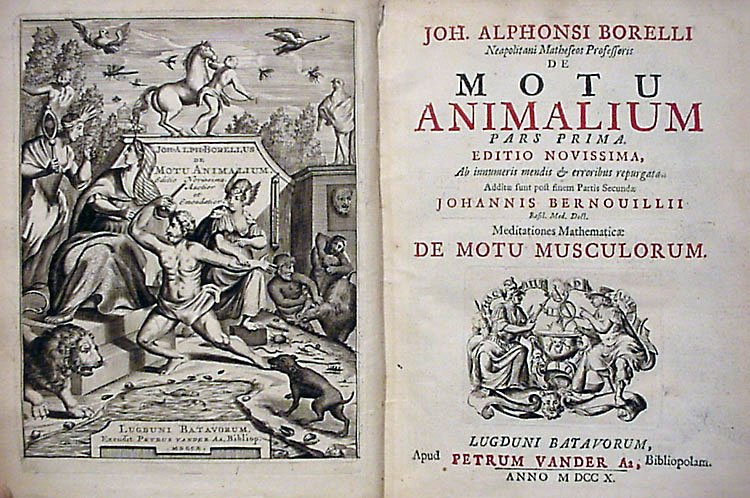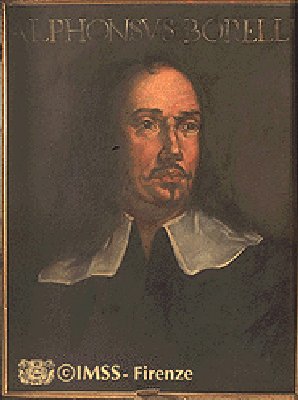
Giovanni Borelli is seen by many as the father of bioengineering because of his studies on muscles, joints, the cardiovascular system, respiration, reproduction and many other aspects of the body which were published in De Motu Animalium (On Animal Motion) after his death. He studied the contraction of the heart and its interaction with the arteries. Interestingly, he clearly understood the capacitive effect of the elastic arteries on smoothing the flow of blood (now known as the Windkessel effect).
... Although the heart does not pour blood into the arteries during its diastoles, the blood does not stop and remain completely immobile and stagnant in the arteries, viscera, flesh and veins when the heart is at rest. The blood keeps moving but with varying velocity… This results from the fact that the arteries themselves are constricted by contraction of their circular fibres.
De Motu Animalium (1680)
Stephen Hales, who is often cited as the originator of the arterial Windkessel model, was certainly familiar with Borelli's work, probably reading it during his student days as Cambridge. Otto Frank cites Hales as the originator of the idea and used the German Windkessel to describe the effect following Hales' comparison of the arteries to the 'air chamber' that was used in fire engine pumps to smooth the intermittent flow of water produced by the reciprocating pumping action. I can find no mention of Borelli in Hales' Statical Essays: containing Haemastaticks, but that is not surprising given the haphazard customs regarding references of the time.